Last updated 2026-07-24
TL;DR
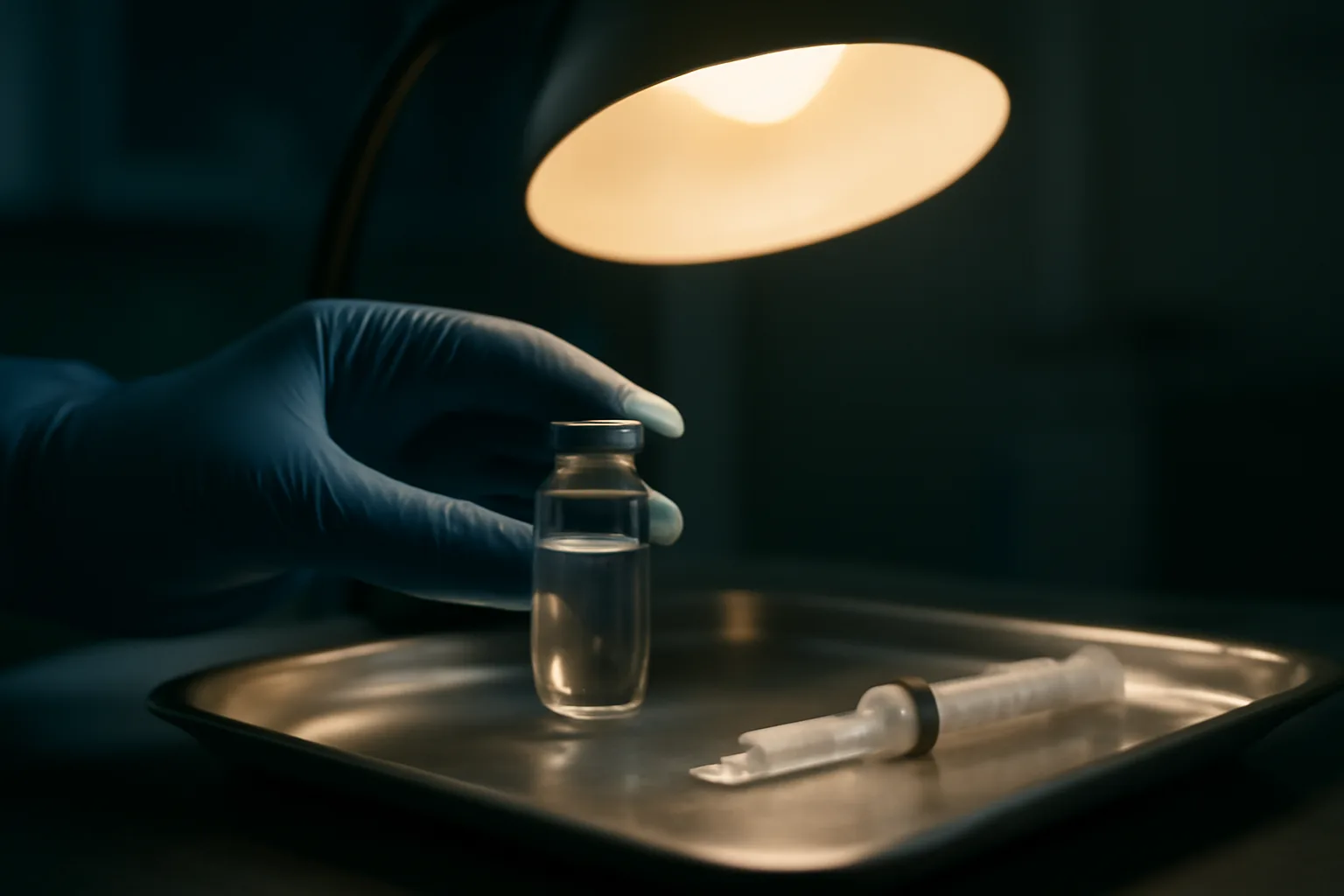
TB-500 is never sold as a standalone product; it's dispensed as a BPC-157/TB-500 blend that arrives as freeze-dried powder needing bacteriostatic water. Reconstitution itself is simple mechanics (water volume, gentle mixing, refrigeration), but the evidence behind the peptide's actual repair effects is almost entirely preclinical, and WADA prohibits it in competition.
What does reconstituting TB-500 actually mean?
Reconstitution just means adding sterile liquid, almost always bacteriostatic water, back into a vial of freeze-dried peptide powder so it can be drawn into a syringe. The powder itself is stable at room temperature for a while, but once liquid, it's a protein in solution, and proteins in solution degrade. Heat, light, agitation, and time all work against you. Here's the thing worth saying up front: there is no standalone TB-500 vial on the market. What providers dispense is a BPC-157/TB-500 blend, combining synthetic TB-500 with BPC-157 in one vial. If you see a listing claiming pure isolated TB-500 with nothing else in it, that's a red flag on the sourcing side, not a product spec you should expect to find. The tb-500-for-sale route worth trusting is one where a licensed pharmacy prepares and labels the blend after a provider review, not a bathroom-tub operation shipping loose powder. The actual peptide identity matters too. TB-500 is a synthetic version of a specific active fragment of thymosin beta-4, not the full native protein. A 2012 analytical chemistry paper characterized the N-terminal acetylated 17-23 fragment of thymosin beta-4 found in commercial TB-500 products, flagging it specifically in the context of doping detection work [1]. That's a narrower molecule than the endogenous protein your body already makes, and mixing up the two is one of the most common errors in how this peptide gets described online. For the full comparison, see thymosin-beta-4-vs-tb-500.
What do you actually need before you reconstitute?
Four things: the freeze-dried vial (the blend), bacteriostatic water (not plain sterile water, not saline), a syringe with a drawing needle to measure the water accurately, and someplace cold and dark to store the finished vial afterward. Bacteriostatic water contains 0.9% benzyl alcohol as a preservative, which is why it's preferred over plain sterile water for multi-dose vials. It buys you weeks of refrigerated shelf life instead of a single-use window. You don't need anything exotic here. What you need is precision on volume and cleanliness on technique, because contamination and heat are the two things that actually wreck a batch. A syringe marked in increments of 0.01 mL to 0.1 mL (an insulin syringe, typically 1 mL / 100 unit) is the standard tool for both reconstitution and dosing draws. If your only syringe is a coarse 3 mL model, you'll struggle to hit accurate small volumes later, so get the right size before you start.
How much bacteriostatic water do you use to reconstitute a TB-500 blend vial?
There's no single universal number, because it depends on the total peptide content of the vial and how concentrated you want the final solution. A common approach is adding enough bacteriostatic water to land somewhere in the 1 to 3 mL range per vial, which keeps the resulting concentration workable with a standard insulin syringe. More water means a more dilute solution, which means you draw a bigger syringe volume for the same dose, easier to measure precisely but requiring more injections' worth of volume. Less water means a more concentrated solution, smaller draw volume, higher risk of measurement error if your syringe isn't fine enough. Neither is objectively "right"; it's a tradeoff between precision and volume. The actual amount should come from whatever your provider or the pharmacy's product insert specifies for that vial's total peptide amount, not a generic online chart. Vial sizes differ across blend formulations, and guessing wastes product or risks dosing error. If you're working out per-vial dosing math after reconstitution, the tb-500-dosage-calculator walks through the concentration arithmetic, and tb-500-dosage covers the dosing ranges discussed in practitioner literature.
What's the right technique for adding the water?
Slow and along the vial wall, not a direct blast onto the powder. Freeze-dried peptide is fragile in structure; a hard stream of liquid or vigorous shaking can denature some of the protein before you've even used it. Insert the needle at an angle, let the water run down the interior glass, and let it settle over the powder rather than injecting straight down into it. Once the water's in, don't shake the vial. Roll it gently between your palms, or just let it sit and swirl on its own for a few minutes. Full dissolution usually takes a couple of minutes; you're looking for a clear solution with no visible particulate or cloudiness. If it looks cloudy after several minutes of gentle rolling, something's off. It could be the water volume, the powder quality, or a genuine solubility problem. Don't inject a cloudy solution.
How should you store a reconstituted TB-500 blend?
Refrigerated, always, once liquid. Room temperature storage after reconstitution is one of the fastest ways to lose potency, because the peptide bonds are heat-sensitive and the clock starts the moment powder meets water. Most peptide handling guidance points to a standard refrigerator range (about 2 to 8°C / 36 to 46°F) for reconstituted vials, kept away from light. A kitchen fridge door is fine as long as the temperature is stable; the back of the fridge, away from the door's temperature swings, is slightly better. Don't freeze a reconstituted vial. Freezing and thawing repeatedly stresses the peptide structure and increases the odds of degradation or aggregation, which shows up as reduced effect for the same dose, not any visible warning sign in the vial.
How long does reconstituted TB-500 actually last?
Realistically, plan on using a reconstituted vial within about 2 to 4 weeks if kept refrigerated and handled cleanly. That's a general peptide-handling window, not a number pulled from a TB-500-specific stability study, and honestly, nobody's published a rigorous shelf-life trial on this exact blend under home storage conditions. What we do have is analytical chemistry work on the molecule itself. A 2024 study using UHPLC and high-resolution mass spectrometry quantified TB-500 and its metabolites in both in-vitro experiments and rats, screening the compound and its breakdown products for wound healing activity in vitro [2]. That tells you the molecule metabolizes into distinct fragments once it's biologically active, which is a separate question from how long the intact peptide survives sitting in a refrigerated vial. Still, it's a good reminder that TB-500 doesn't sit around unchanged forever, in a fridge or in a body. Signs a vial has gone bad: persistent cloudiness that doesn't clear, discoloration, or a vial that's been left out at room temperature for more than a few hours. When in doubt, don't use it. The cost of tossing a questionable vial is much lower than the cost of injecting something degraded or contaminated.
What actually happens once TB-500 is in the body, and how much of that is proven?
Here's where you need to be honest about the evidence gap. The bulk of what's written about TB-500's tissue repair effects, cell migration, angiogenesis, reduced inflammation, comes from preclinical work: cell culture and animal studies, not controlled human trials. A 2026 review in the Journal of the American Academy of Orthopaedic Surgeons' Global Research & Reviews looked at therapeutic peptides in orthopaedics broadly, covering applications, challenges, and future directions for the field [3]. A companion piece the same year in the American Journal of Sports Medicine framed injectable peptide therapy as a primer specifically for orthopaedic and sports medicine physicians, meaning the target audience is clinicians trying to make sense of a fast-moving, poorly regulated space [4]. Neither of these is a green light for TB-500 specifically; they're evidence that the medical literature is actively trying to catch up to what's already being used off-label. More pointedly, a 2026 paper in Sports Medicine (Auckland) examined the safety and efficacy of both approved and unapproved peptide therapies for musculoskeletal injuries and athletic performance [5], a framing that puts TB-500 squarely in the "unapproved" bucket alongside other peptides circulating in sports medicine settings without FDA approval for these uses. Separately, a 2026 Frontiers in Aging paper reviewed therapeutic peptides in gerontology, covering mechanisms and applications relevant to healthy aging [6], which gives you a sense of how broad the peptide research field has gotten, but again isn't a TB-500 human trial. If you want the fuller evidence rundown before you commit to sourcing anything, start at tb-500.
Is TB-500 FDA-approved, and does that affect how it's dispensed?
No. There's no TB-500 product listed in Drugs@FDA, the FDA's database of approved drug products [7], and TB-500 does not appear on either FDA bulk drug substance list that governs what compounding pharmacies can legally use. The two relevant lists are the 503A bulks list under 21 CFR 216.23, covering substances traditional compounding pharmacies may use [8], and the 503B bulks list under 21 CFR 216.24, covering outsourcing facilities [9]. Compounding itself is authorized under 21 U.S.C. 353a for licensed pharmacies working from a valid prescription [10], but that authorization only extends to substances FDA has cleared for compounding use, and TB-500's regulatory status there is unsettled, not a green light. What this means practically: any legitimate provider-reviewed pathway routes through a pharmacy operating under a compounding framework and a prescriber's assessment, not a supplement-aisle purchase. It also means claims of "FDA-approved TB-500" anywhere online are simply false, full stop.
Does TB-500 show up on drug tests, and does WADA ban it?
Yes to both. The World Anti-Doping Agency prohibits TB-500 (and thymosin beta-4 more broadly) as a peptide with growth factor-like effects, and it's specifically been a target of doping-control analytical development for over a decade. A 2012 study in the Journal of Chromatography A developed a liquid chromatography-mass spectrometry method to detect TB-500 in equine urine and plasma [11], which tells you the compound has a real history in horse racing doping cases before it became an internet fitness product. A separate 2013 paper in Analytical and Bioanalytical Chemistry covered doping control analysis of seven bioactive peptides, TB-500 among them, in horse plasma [12]. Detection science has moved into human anti-doping work too. A 2014 paper in the Journal of Pharmaceutical and Biomedical Analysis reviewed analytical approaches for detecting emerging therapeutics and non-approved drugs in human doping controls [13], and a 2014 Expert Review of Proteomics paper covered the broader challenge of detecting peptidic drugs and analogs in sports doping [14]. A 2017 Analytical Biochemistry study specifically looked at adsorption effects for doping-relevant peptides including TB-500 and GHRP-5, relevant to how these compounds behave in sample handling during testing [15]. If you're a tested athlete, this isn't a gray area. TB-500 is detectable, it's prohibited, and the analytical infrastructure to catch it already exists and keeps getting more sensitive.
What are the most common reconstitution mistakes?
Shaking the vial hard instead of rolling it gently is probably the single most common one; it can shear the peptide structure and reduce potency before you've drawn a single dose. Using plain sterile water or saline instead of bacteriostatic water is another. Without the benzyl alcohol preservative, you're looking at a same-day-use vial, not something that survives a few weeks refrigerated. Guessing at water volume without knowing the vial's actual peptide content leads to concentration errors that throw off every dose calculation downstream. And leaving a reconstituted vial out at room temperature, even for a few hours during travel or a busy day, accelerates degradation in a way you can't see or reverse. Last one: mixing multiple vials together or reusing a syringe across vials without a fresh needle. That's a straightforward contamination risk, not a peptide-chemistry one, but it's just as capable of ruining a batch or causing an infection at the injection site.
Reconstitution at a glance
| Step | What to do | Why it matters |
|---|---|---|
| Water choice | Bacteriostatic water, not saline or plain sterile water | Benzyl alcohol preservative extends usable shelf life |
| Water volume | Typically 1 to 3 mL per vial, per product instructions | Sets final concentration; affects draw volume per dose |
| Mixing technique | Roll gently along vial wall, no shaking | Preserves peptide structure |
| Dissolution check | Solution should be clear within minutes | Cloudiness signals a problem |
| Storage temp | Refrigerated, 2 to 8°C (36 to 46°F) | Heat accelerates peptide breakdown |
| Usable window | Roughly 2 to 4 weeks refrigerated | General peptide handling guidance, not a TB-500-specific stability trial |
| Freezing | Avoid after reconstitution | Freeze-thaw cycles stress and degrade the peptide |
How does TB-500 reconstitution differ from BPC-157's, since they come in the same vial?
They don't differ mechanically. Because TB-500 is dispensed as a blend with BPC-157, you're reconstituting both peptides at once, in the same vial, with the same water, using the same technique. There's no separate reconstitution step for each component. What differs is the underlying molecule and its evidence base. BPC-157 is a synthetic peptide derived from a fragment of a protein found in gastric juice, studied mostly for gut and tendon healing in animal models. TB-500 is derived from a fragment of thymosin beta-4, studied mostly for cell migration, wound healing, and angiogenesis, again mostly in cell and animal models. A 2024 chromatography and mass spectrometry study specifically screened TB-500 and its metabolites for wound healing activity in vitro, giving some mechanistic grounding to that side of the pairing [2]. The practical upshot for reconstitution is simple: whatever water volume and technique the blend vial's instructions specify, that's what governs the whole vial, not a per-peptide split you have to calculate separately.
Where does the actual sourcing decision matter here?
Reconstitution technique is the same regardless of where the vial came from, but vial quality, labeling accuracy, and sterility absolutely are not the same across sources. This is where a provider-reviewed pathway earns its keep. TB-500 Co works within a model where a provider reviews the case and a compounding pharmacy partner prepares the BPC-157/TB-500 blend under pharmacy oversight, rather than a reader sourcing loose powder from an unregulated peptide vendor with no chain of custody. That doesn't make the underlying evidence for TB-500 any stronger than what the preclinical literature actually shows [3][4][5], but it does mean the vial you're reconstituting has a documented, traceable origin instead of an unknown one. If you're still comparing sourcing options, tb-500-for-sale covers what a legitimate pathway looks like versus red flags, and is-tb-500-safe covers the safety picture beyond just the reconstitution step.
Frequently asked questions
Can you use regular water to reconstitute TB-500?
No. Use bacteriostatic water, which contains 0.9% benzyl alcohol as a preservative. Plain sterile water or tap water lacks that preservative, meaning the vial has to be used almost immediately and carries a higher contamination risk over any storage period.
How much bacteriostatic water do you add to a TB-500 blend vial?
Typically 1 to 3 mL, depending on the vial's total peptide content and the concentration you want for dosing. There's no single universal number; follow the specific instructions for your vial's labeled peptide amount rather than a generic online chart.
Does TB-500 need to be refrigerated after mixing?
Yes, always, once it's liquid. Reconstituted peptide should be kept at standard refrigerator temperature (about 2 to 8°C / 36 to 46°F) and used within roughly 2 to 4 weeks. Room temperature storage after reconstitution speeds up degradation.
Can you buy TB-500 as a standalone product?
Not through a legitimate provider-reviewed pathway. TB-500 is dispensed as a BPC-157/TB-500 blend, not a standalone SKU. Listings claiming pure isolated TB-500 alone are a sourcing red flag, not a normal product variant.
Is TB-500 the same thing as thymosin beta-4?
No. TB-500 is a synthetic version of a specific active fragment of thymosin beta-4, not the full native protein. A 2012 analytical study characterized the N-terminal acetylated 17-23 fragment found in commercial TB-500 specifically, distinguishing it from endogenous thymosin beta-4.
Is TB-500 FDA-approved?
No. There's no TB-500 listing in Drugs@FDA, and it doesn't appear on the FDA's 503A or 503B bulk drug substance lists that govern what compounding pharmacies may legally use. Any "FDA-approved TB-500" claim online is false.
Will TB-500 show up on a drug test?
Yes. Analytical methods for detecting TB-500 in urine and plasma have existed since at least 2012, originally developed for equine doping control and since adapted for human anti-doping testing. WADA prohibits TB-500 as a peptide with growth factor-like effects.
What happens if you shake a TB-500 vial instead of rolling it?
Vigorous shaking can shear and denature the peptide structure, reducing potency before you've used the product. Add water slowly along the vial wall and mix by gentle rolling or swirling, never a hard shake.
How do you know if reconstituted TB-500 has gone bad?
Persistent cloudiness that doesn't clear after gentle mixing, visible discoloration, or particulate matter are signs to discard the vial. Any vial left at room temperature for an extended period, or one past roughly 4 weeks refrigerated, should be treated with suspicion.
Can you freeze a reconstituted TB-500 vial to make it last longer?
It's not recommended. Freeze-thaw cycles stress the peptide's structure and can cause aggregation or degradation, undermining the point of storing it carefully in the first place. Refrigeration, not freezing, is the standard storage approach after reconstitution.
Why is TB-500 always paired with BPC-157 instead of sold alone?
This reflects how the product is currently formulated and dispensed by compounding pharmacies in this space; there is no standalone TB-500 SKU on the market. The two peptides are studied for different, sometimes complementary preclinical repair mechanisms, but the vial itself is a single blended product, not two separate reconstitution processes.
Does human evidence support TB-500 for tissue repair?
Mostly not yet. Human clinical trial data is limited; most of what's published is preclinical, meaning cell culture and animal studies. Recent 2026 reviews in orthopaedic and sports medicine journals frame TB-500 among unapproved peptide therapies where clinicians are still working out safety and efficacy questions.
Sources
- Drug Testing and Analysis, 2012 (PMID 22962027): Characterized the N-terminal acetylated 17-23 fragment of thymosin beta-4 identified in commercial TB-500 products, distinguishing it from native thymosin beta-4
- Journal of Chromatography B, 2024 (PMID 38382158): Quantified TB-500 and its metabolites in in-vitro experiments and rats using UHPLC-Q-Exactive orbitrap MS/MS, and screened them for wound healing activity in vitro
- Journal of the American Academy of Orthopaedic Surgeons, Global Research & Reviews, 2026 (PMID 41490200): Reviewed therapeutic peptides in orthopaedics, covering applications, challenges, and future directions for the field
- American Journal of Sports Medicine, 2026 (PMID 41476424): Framed injectable peptide therapy as a primer specifically for orthopaedic and sports medicine physicians navigating an unregulated peptide landscape
- Sports Medicine (Auckland), 2026 (PMID 41966639): Examined safety and efficacy of both approved and unapproved peptide therapies for musculoskeletal injuries and athletic performance
- Frontiers in Aging, 2026 (PMID 42021992): Reviewed therapeutic peptide mechanisms and applications relevant to healthy aging
- Drugs@FDA, FDA-approved drug products database: No TB-500 product is listed as an FDA-approved drug in this database
- 21 CFR 216.23, the final 503A Bulks List: Lists the bulk drug substances traditional compounding pharmacies may legally use under 503A; TB-500's status there is unsettled
- 21 CFR 216.24, the 503B Bulks List: Lists the bulk drug substances outsourcing facilities may use under 503B compounding rules
- 21 U.S.C. 353a, pharmacy compounding: Establishes the legal framework under which licensed pharmacies may compound drug products from a valid prescription
- Journal of Chromatography A, 2012 (PMID 23084823): Developed an LC-MS method to detect TB-500 in equine urine and plasma for doping control purposes
- Analytical and Bioanalytical Chemistry, 2013 (PMID 23318763): Covered doping control analysis of seven bioactive peptides including TB-500 in horse plasma
- Journal of Pharmaceutical and Biomedical Analysis, 2014 (PMID 24906629): Reviewed analytical approaches for detecting emerging therapeutics and non-approved drugs in human doping controls
- Expert Review of Proteomics, 2014 (PMID 25382550): Reviewed current status and future directions for detecting peptidic drugs and analogs in sports doping
- Analytical Biochemistry, 2017 (PMID 28887173): Studied adsorption effects for doping-relevant peptides including TB-500 and GHRP-5 relevant to sample handling in testing