Last updated 2026-07-24
TL;DR
TB-500 (a synthetic fragment related to thymosin beta-4) comes as a lyophilized powder that needs bacteriostatic or sterile water added before use. Reconstitution itself is simple math and clean technique, but there is no standalone TB-500 product on the legitimate market. It's dispensed as a BPC-157/TB-500 blend, and the human clinical evidence for dosing or outcomes doesn't exist yet.
what does it mean to reconstitute TB-500?
Reconstitution just means adding liquid to a freeze-dried (lyophilized) powder so it becomes an injectable solution. TB-500 ships as a sealed vial of white or off-white powder. On its own, that powder does nothing. You add a fixed volume of bacteriostatic water (or sterile water without preservative) to hit a target concentration, then draw doses from the resulting solution with an insulin syringe. The process is mechanically identical to reconstituting insulin or HGH, which is why a lot of the technique guidance floating around the internet is copy-pasted from those contexts. The math is the same. What's different is that TB-500 isn't an FDA-approved drug, so there's no package insert, no approved diluent, and no clinical dosing chart to check your work against. You're relying on peptide chemistry norms and vial labeling from the compounding pharmacy, not an FDA label. One clarification worth making up front: TB-500 is not identical to native thymosin beta-4 (Tβ4), the actin-binding protein your body makes on its own. TB-500 refers to a synthetic version of an active region of that molecule, and lab work has actually mapped out what's in a commercial TB-500 product versus the natural peptide, including metabolites that show up when it's tested in vitro and in rats [1]. Same neighborhood, not the same building. See thymosin beta-4 vs TB-500 for the full comparison.
what do you actually need before you start?
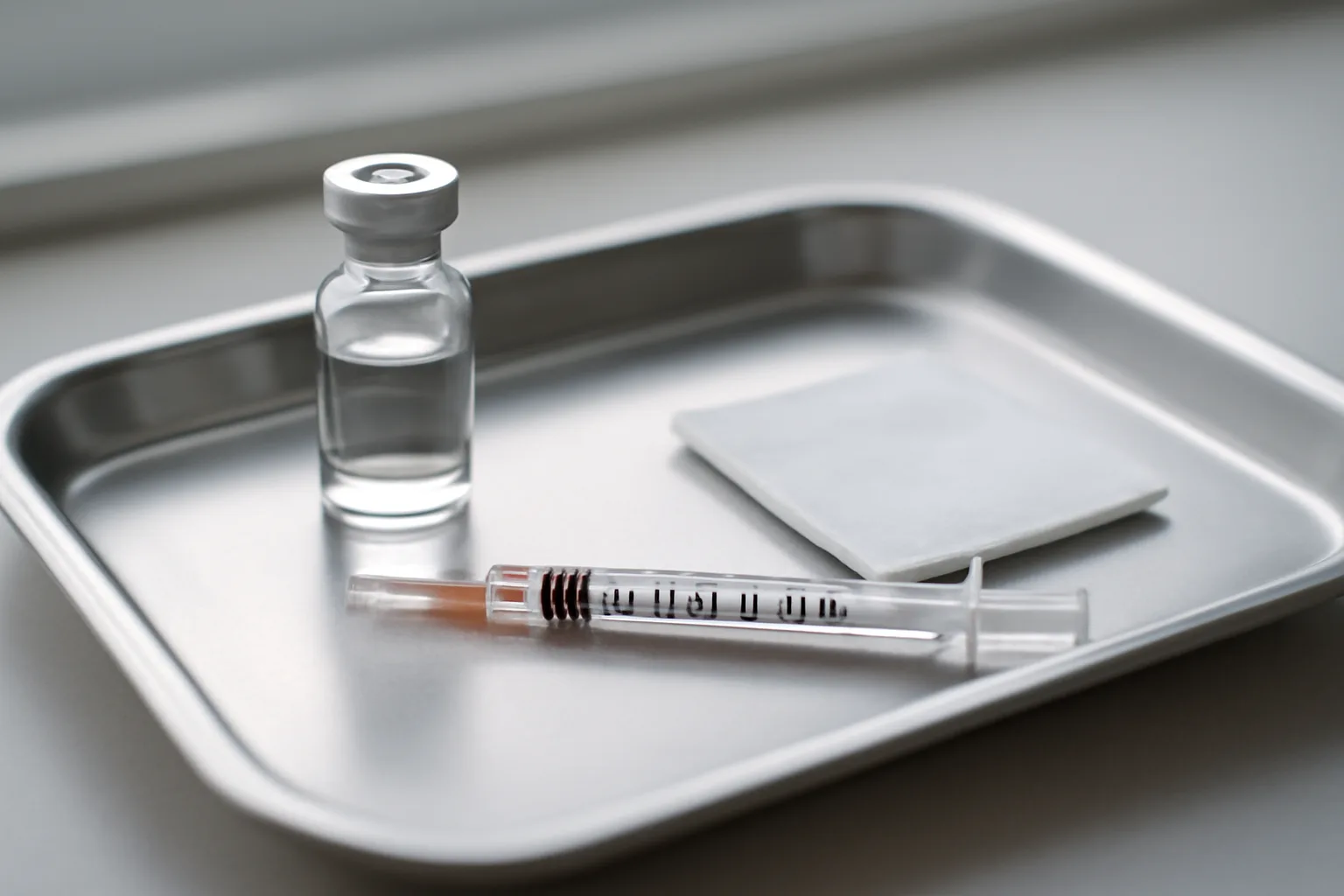
You need five things: the sealed TB-500 vial, bacteriostatic water (or sterile water for injection), a syringe to inject diluent into the vial, alcohol swabs, and a fine-gauge insulin syringe (typically 29-31 gauge, 0.5 mL or 1 mL) for dosing afterward. Bacteriostatic water contains 0.9% benzyl alcohol as a preservative, which is why it's the preferred diluent for multi-dose vials that will sit in the fridge for weeks. Sterile water has no preservative, so once you add it, the clock starts, and you're expected to use the whole vial fast (more on timelines below). Neither of these is available over the counter at a regular pharmacy without a prescription in most states; they're typically sourced through the same channel that supplies the peptide itself. Don't shake the vial. Ever. Lyophilized peptides are fragile, and vigorous agitation can denature the protein structure, which is the same mechanical concern that shows up across peptide handling literature generally, not something specific to TB-500. Swirl gently or let it sit and dissolve on its own.
how much water do you add, and how do you figure out the dose per click?
There's no single right number. The volume of diluent you add sets the concentration, and the concentration determines how many international units (IU) on an insulin syringe equal one milligram of peptide. Pick a diluent volume that gives you a concentration you can dose accurately on a standard insulin syringe. Here's the arithmetic, using a common vial size as the example:
| Vial size | Diluent added | Resulting concentration | 250 mcg dose = | 500 mcg dose = |
|---|---|---|---|---|
| 5 mg | 2 mL | 2.5 mg/mL (2,500 mcg/mL) | 0.1 mL (10 IU) | 0.2 mL (20 IU) |
| 5 mg | 1 mL | 5 mg/mL (5,000 mcg/mL) | 0.05 mL (5 IU) | 0.1 mL (10 IU) |
| 2 mg | 2 mL | 1 mg/mL (1,000 mcg/mL) | 0.25 mL (25 IU) | 0.5 mL (50 IU) |
An insulin syringe is marked in units where 100 IU = 1 mL, so 1 IU = 0.01 mL. Once you know your concentration in mcg/mL, divide your target dose by that concentration to get the mL, then multiply by 100 to get IU on the syringe. If you'd rather not do this by hand every time, run the numbers through a TB-500 dosage calculator and cross-check against the TB-500 dosage reference before you draw anything into a syringe. Getting this step wrong is the single most common practical mistake, not because the math is hard, but because it's easy to mislabel a vial after mixing and lose track of which concentration is in which container.
what water should you use, bacteriostatic or sterile?
Bacteriostatic water is the standard choice for TB-500 because the benzyl alcohol preservative lets the reconstituted vial last for weeks in the refrigerator instead of needing to be used in a day or two. Sterile water (no preservative) is used only when someone has a benzyl alcohol sensitivity, and it demands much faster use. This distinction matters more than people give it credit for. A reconstituted vial with bacteriostatic water, kept cold and handled with clean technique, is commonly treated as good for around 4 weeks based on general peptide-handling convention (this isn't a TB-500-specific clinical finding, it's standard practice for compounded peptide vials generally). Without the preservative, you're looking at days, not weeks, before contamination risk climbs. Don't mix the two diluent types in the same vial and don't reuse a needle that's touched anything other than the stopper. Every draw into the vial is a chance to introduce bacteria if your swabbing technique is sloppy.
step-by-step: how do you reconstitute the vial?
1. Bring the peptide vial and diluent to room temperature if they've been refrigerated. Cold powder and cold liquid mixing too fast can create more foam. 2. Swab the rubber stopper on both vials with an alcohol wipe. Let it dry for a few seconds. 3. Draw your calculated volume of bacteriostatic water into the syringe. 4. Insert the needle into the diluent vial at an angle, aiming the stream at the inside wall of the glass rather than directly onto the powder. This slows the flow down. 5. Let the water run down the wall and settle over the powder. Don't inject it in a hard stream straight onto the lyophilized cake, that's the fastest way to cause foaming and potential protein damage. 6. Remove the needle. Gently swirl or roll the vial between your palms until the powder is fully dissolved. It should look clear, with no visible particles or cloudiness. 7. Label the vial immediately with the date and final concentration. This step gets skipped constantly and it's how people end up dosing the wrong amount two weeks later. 8. Store in the refrigerator, away from light.
how do you store it after mixing, and how long is it good for?
Keep the reconstituted vial refrigerated at all times, ideally between 36 to 46°F (roughly 2 to 8°C), and out of direct light. Don't freeze it. Freezing and thawing a peptide solution risks breaking down the molecule's structure. With bacteriostatic water as the diluent, a commonly cited handling window is about 4 weeks refrigerated, though this comes from general peptide compounding practice rather than a TB-500-specific stability study. There is no FDA-reviewed shelf-life data for reconstituted TB-500 because it isn't an approved drug with a monograph. Anyone who tells you an exact expiration date with total confidence is guessing, or extrapolating from insulin and HGH handling norms. If the solution ever turns cloudy, changes color, or shows particles floating in it after it was previously clear, discard it. That's a sign of either degradation or contamination, and neither is worth troubleshooting.
why isn't there a standalone TB-500 product to reconstitute?
Because TB-500 doesn't exist as an FDA-approved drug, it isn't sold as a stand-alone retail SKU through legitimate channels. What you'll find dispensed through a compounding pharmacy is a BPC-157/TB-500 blend, combined into a single vial rather than sold separately. This matters for reconstitution because a blended vial has two peptides at two different concentrations in the same solution, and the math above needs to account for both. A pharmacy dispensing a blend will typically specify the combined dose per mL on the label, and that's the number to build your dosing math around, not a generic single-peptide chart pulled from a forum. Under federal compounding law, pharmacies operating under 21 U.S.C. 353a (section 503A) can only compound with bulk substances that appear on FDA's approved bulks lists, laid out in 21 CFR 216.23 for 503A facilities and 21 CFR 216.24 for larger 503B outsourcing facilities [source: eCFR 216.23, eCFR 216.24]. Whether a given peptide is compoundable at all depends on its current status on those lists, which FDA maintains and updates [source: FDA bulk drug substances page]. This is regulatory context, not a guarantee of legality for any specific product; check current listing status before assuming anything is compoundable.
what does the actual research say TB-500 does, if anything?
Almost everything published on TB-500 and thymosin beta-4 tissue repair is preclinical, meaning cell culture and animal studies, not human trials. That's a real gap, not a technicality. A 2024 analytical chemistry paper built out methods to quantify TB-500 and its metabolites in both in-vitro experiments and in rats, and screened the compound's wound-healing activity in vitro as part of validating those methods [1]. That's useful for understanding what the molecule breaks down into and how labs can detect it, but it's not a clinical efficacy trial in humans. Broader reviews of the orthopaedic peptide space have started cataloguing where these compounds sit. A 2026 review in the Journal of the American Academy of Orthopaedic Surgeons Global Research & Reviews looked at therapeutic peptides in orthopaedics generally, covering applications, challenges, and where the field needs to go next [2]. A companion piece in The American Journal of Sports Medicine positioned itself as a primer for orthopaedic and sports medicine physicians on injectable peptide therapy broadly [3]. And a 2026 Sports Medicine (Auckland) paper specifically framed the safety and efficacy picture for both approved and unapproved peptide therapies used for musculoskeletal injuries and athletic performance [4], which is the closest thing to a direct answer on where TB-500 stands relative to genuinely approved options, none of which currently include TB-500 itself in the FDA's approved drug database [source: Drugs@FDA]. Separately, a 2026 Frontiers in Aging review covered therapeutic peptides in gerontology, looking at mechanisms and applications for healthy aging broadly [5]. That's relevant context for the peptide category as a whole but isn't a TB-500-specific aging trial. Read the full picture at TB-500 if you want the evidence rundown before deciding whether reconstitution and use makes sense for you.
is TB-500 tested for in anti-doping, and does that affect handling?
Yes. TB-500 is on anti-doping radar and has been the subject of dedicated detection method development for over a decade, which tells you regulators and testing labs take it seriously as a performance-and-recovery substance, not a supplement footnote. A 2012 paper in the Journal of Chromatography A developed a liquid chromatography-mass spectrometry method specifically for detecting TB-500 in equine urine and plasma [6], and a companion 2012 paper in Drug Testing and Analysis synthesized and characterized the N-terminal acetylated 17-23 fragment of thymosin beta-4 identified in TB-500 specifically because it was suspected to carry doping potential [7]. A 2013 method in Analytical and Bioanalytical Chemistry extended doping control analysis to seven bioactive peptides, TB-500 included, in horse plasma [8]. The human side has kept pace. A 2014 review in Expert Review of Proteomics covered detecting peptidic drugs, drug candidates, and analogs in sports doping broadly, discussing current status and future directions for the field [9], and a 2014 paper in the Journal of Pharmaceutical and Biomedical Analysis reviewed analytical approaches for detecting emerging therapeutics and non-approved drugs in human doping controls [10]. More technical method papers have picked apart the practical challenges: a 2016 Journal of Separation Science paper worked on simplifying and expanding screening for peptides under 2 kDa using direct urine injection with liquid chromatography and ion mobility mass spectrometry [11], a 2016 Drug Testing and Analysis paper developed solid-phase extraction methods for small bioactive peptides from human urine using cartridges and microelution plates [12], and a 2017 Analytical Biochemistry paper specifically studied adsorption effects for several doping-relevant peptides including TB-500 [13]. Metabolism modeling matters too, since what a lab detects is often a breakdown product, not the parent compound. A 2015 Journal of Peptide Science paper reviewed in-vitro models for metabolic studies of small peptide hormones in sport drug testing [14], and a 2016 Journal of Proteomics paper compared various in-vitro model systems, including proteolytic enzymes, human blood serum, liver and kidney microsomes, and liver S9 fraction, for metabolizing synthetic doping peptides [15]. The bottom line for athletes: TB-500 is prohibited under the World Anti-Doping Agency's list, and the detection science behind that prohibition is mature and still being refined. If you compete under any WADA-code testing program, reconstituting and using TB-500 is a straightforward doping violation risk, not a gray area.
what mistakes ruin a batch or waste money?
Shaking the vial hard enough to foam it is probably the most common self-inflicted damage. Agitation can denature the peptide structure, and once that happens, no amount of gentle handling afterward fixes it. Using the wrong diluent volume and then losing track of concentration is the second most common issue, not a chemistry failure but a bookkeeping one. Label every vial the moment you mix it: date, total mg, total mL, resulting concentration. If you have more than one vial in the fridge at once (which is common if you're running a BPC-157/TB-500 blend alongside anything else), unlabeled vials are how people accidentally double or halve a dose. Skipping the swab step, or reusing a needle that already went into skin, on the vial stopper introduces bacteria into a vial you intend to keep for weeks. That's the mechanism behind most injection-site infections tied to peptide use generally, and it's entirely preventable with a fresh alcohol wipe every single draw. And don't buy from a source that won't tell you what's actually in the vial. See is TB-500 safe for the fuller safety and sourcing risk picture, because reconstitution technique means nothing if the powder itself isn't what the label says.
where does this leave someone deciding whether to actually use it?
If you've read this far, you already know the honest state of things: reconstitution technique is simple and well understood, but the underlying evidence for what TB-500 does in a human body, at what dose, for how long, is thin and almost entirely preclinical [2][3][4]. That's a real gap between how confidently the peptide is talked about online and what's actually been shown in controlled human research. TB-500 Co works with a provider-reviewed route where a licensed provider evaluates whether a BPC-157/TB-500 blend fits your situation, and the fulfilling pharmacy partner handles compounding under the standard pharmacy framework rather than you sourcing raw powder from an unverified vendor. That doesn't change the evidence base, but it does remove the guessing around purity, concentration accuracy, and sterile technique that a home reconstitution kit can't guarantee. Whatever route you take, don't skip the labeling step, don't shake the vial, and don't assume a forum's dosing chart is a substitute for a real concentration calculation done from your specific vial's label.
Frequently asked questions
How much bacteriostatic water do I add to a TB-500 vial?
There's no fixed universal answer. It depends on the vial's total mg and the concentration you want for accurate insulin syringe dosing. A common approach for a 5 mg vial is 1-2 mL of bacteriostatic water, giving 2.5-5 mg/mL. Use a dosage calculator with your specific vial size to avoid guessing.
Can I use sterile water instead of bacteriostatic water?
Yes, if you have a benzyl alcohol sensitivity. Sterile water has no preservative, so the reconstituted vial must be used much faster, typically within a day or two, versus the weeks-long window bacteriostatic water allows in the refrigerator. Most people default to bacteriostatic water for this reason.
How long does reconstituted TB-500 last in the fridge?
General peptide-handling convention puts refrigerated, bacteriostatic-water-mixed vials at around 4 weeks of usable life, though this isn't from a TB-500-specific stability study; it's standard practice carried over from other peptides. Discard immediately if the solution turns cloudy or shows particles.
Why does the vial foam or turn cloudy when I mix it?
Foaming usually comes from injecting the diluent too fast or directly onto the powder instead of down the vial wall. Cloudiness after mixing (versus turning cloudy later) can mean incomplete dissolving or a manufacturing issue. Either way, don't inject a solution that isn't clear.
Is TB-500 the same thing as thymosin beta-4?
No. TB-500 is a synthetic version of an active region of thymosin beta-4 (Tβ4), not the full native protein your body produces. Lab analysis has characterized the specific fragment sold as TB-500 and shown it has distinct metabolites from the natural peptide [1]. See thymosin beta-4 vs TB-500 for the detailed breakdown.
Can I buy TB-500 by itself, without BPC-157?
Through legitimate compounding pharmacy channels, no. TB-500 is dispensed as a BPC-157/TB-500 blend rather than a standalone SKU. If you find a source selling pure TB-500 alone with no oversight, treat that as a sourcing red flag rather than a convenience.
Is TB-500 legal to buy and use?
It isn't FDA-approved as a drug for any use, so it doesn't appear in the Drugs@FDA database of approved products. Compounding pharmacies operate under specific bulk substance rules (21 CFR 216.23 and 216.24), and legality of any given product depends on current listing status and how it's marketed, not a blanket yes or no.
Does TB-500 show up on a drug test?
It can, if the testing panel is built to look for it. TB-500 has dedicated LC-MS detection methods developed specifically for anti-doping purposes going back to at least 2012 [6][7], and it's prohibited under the WADA code. Athletes under any testing program should not assume it's undetectable.
What syringe size do I need to inject reconstituted TB-500?
A standard insulin syringe, typically 29-31 gauge and marked in units (100 IU = 1 mL), is the usual choice for drawing small, precise volumes after reconstitution. The exact syringe size matters less than making sure your concentration math matches the unit markings correctly.
What happens if I shake the vial instead of swirling it?
Vigorous shaking risks denaturing the peptide's protein structure through mechanical stress and excess foaming, which can reduce whatever activity the compound has. Gentle swirling or rolling between your palms until the powder fully dissolves is the standard, lower-risk technique.
Does reconstituted TB-500 need to be refrigerated the whole time?
Yes. Keep it refrigerated (roughly 36-46°F / 2-8°C), away from light, and never frozen. Leaving a reconstituted vial at room temperature for extended periods speeds degradation and raises contamination risk, especially with sterile water instead of bacteriostatic water.
Is there human clinical trial data on TB-500 dosing?
Not in the way you'd want for a real dosing protocol. Current published work, including 2026 reviews in JAAOS Global Research & Reviews [2], The American Journal of Sports Medicine [3], and Sports Medicine (Auckland) [4], covers the peptide therapy landscape broadly, but TB-500-specific human efficacy and dosing trials are not established in the way FDA-approved drugs are.
Sources
- Journal of Chromatography B, 2024 (PMID 38382158): Method development quantifying TB-500 and its metabolites in vitro and in rats, with wound-healing activity screening in vitro.
- Journal of the American Academy of Orthopaedic Surgeons Global Research & Reviews, 2026 (PMID 41490200): Review of therapeutic peptides in orthopaedics covering applications, challenges, and future directions.
- The American Journal of Sports Medicine, 2026 (PMID 41476424): Primer for orthopaedic and sports medicine physicians on injectable peptide therapy.
- Sports Medicine (Auckland), 2026 (PMID 41966639): Review of safety and efficacy of approved and unapproved peptide therapies for musculoskeletal injuries and athletic performance.
- Frontiers in Aging, 2026 (PMID 42021992): Review of therapeutic peptide mechanisms and applications for healthy aging in gerontology.
- Journal of Chromatography A, 2012 (PMID 23084823): LC-MS doping control method developed for detecting TB-500 in equine urine and plasma.
- Drug Testing and Analysis, 2012 (PMID 22962027): Synthesis and characterization of the N-terminal acetylated 17-23 thymosin beta-4 fragment identified in TB-500, studied for doping potential.
- Analytical and Bioanalytical Chemistry, 2013 (PMID 23318763): LC-MS doping control method covering seven bioactive peptides including TB-500 in horse plasma.
- Expert Review of Proteomics, 2014 (PMID 25382550): Review of current status and future directions for detecting peptidic drugs and analogs in sports doping.
- Journal of Pharmaceutical and Biomedical Analysis, 2014 (PMID 24906629): Review of analytical approaches for detecting emerging therapeutics and non-approved drugs in human doping controls.
- Journal of Separation Science, 2016 (PMID 26578461): Method for screening peptides under 2 kDa using direct urine injection with LC and ion mobility MS.
- Drug Testing and Analysis, 2016 (PMID 26472487): Solid-phase extraction method development for small bioactive peptides from human urine.
- Analytical Biochemistry, 2017 (PMID 28887173): Study of adsorption effects for doping-relevant peptides including TB-500.
- Journal of Peptide Science, 2015 (PMID 25469748): Review of in-vitro models used for metabolic studies of small peptide hormones in sport drug testing.
- Journal of Proteomics, 2016 (PMID 27569051): Comparison of in-vitro model systems, including microsomes and serum, for metabolizing synthetic doping peptides.
- eCFR, 21 CFR 216.23 (503A Bulks List): Defines the bulk drug substances list that 503A compounding pharmacies may use.
- eCFR, 21 CFR 216.24 (503B Bulks List): Defines the bulk drug substances list that 503B outsourcing facilities may use.
- FDA, Bulk Drug Substances Used in Compounding Under Section 503A: FDA maintains and updates the list determining which bulk substances are compoundable under 503A.
- Drugs@FDA database: TB-500 does not appear as an FDA-approved drug product in the Drugs@FDA database.