Last updated 2026-07-25
TL;DR
Most research protocols use subcutaneous injection in the abdomen, near the injury site, or rotate among the thigh, glute, and belly fat. Intramuscular near a specific injury is common in informal use but has no controlled human data behind it. TB-500 is dispensed as a BPC-157/TB-500 blend, not a standalone product, and it's WADA prohibited.
What is TB-500 and how is it actually injected in research settings?
TB-500 is a synthetic peptide built from a 43-amino-acid stretch of thymosin beta-4, the naturally occurring protein involved in cell migration and wound healing. It is not identical to native thymosin beta-4. It is a fragment analog, and sloppy sourcing online treats the two as interchangeable when they are not. The actual research record on TB-500 is mostly analytical chemistry and doping-detection work, not clinical injection trials in humans. A 2024 paper developed and validated a method to quantify TB-500 and its metabolites in vitro and in rats, and screened the resulting fragments for wound-healing activity in cell culture [1]. That is a lab assay, not a human dosing study, and it does not establish an injection site protocol for people. A 2026 orthopaedic sports medicine primer aimed at physicians describes injectable peptide therapies broadly, including how these compounds are handled clinically as a category, but again this is guidance for clinicians navigating an unregulated space, not a site-specific dosing trial for TB-500 itself [2]. A companion 2026 review in the same specialty area covers applications and challenges of therapeutic peptides in orthopaedics generally [3]. There is no standalone TB-500 product available through any legitimate route. Where it's dispensed at all, it comes as a BPC-157/TB-500 blend, because compounding pharmacies working from research formulations pair the two peptides rather than offering TB-500 alone.
Subcutaneous or intramuscular: which do people actually use?
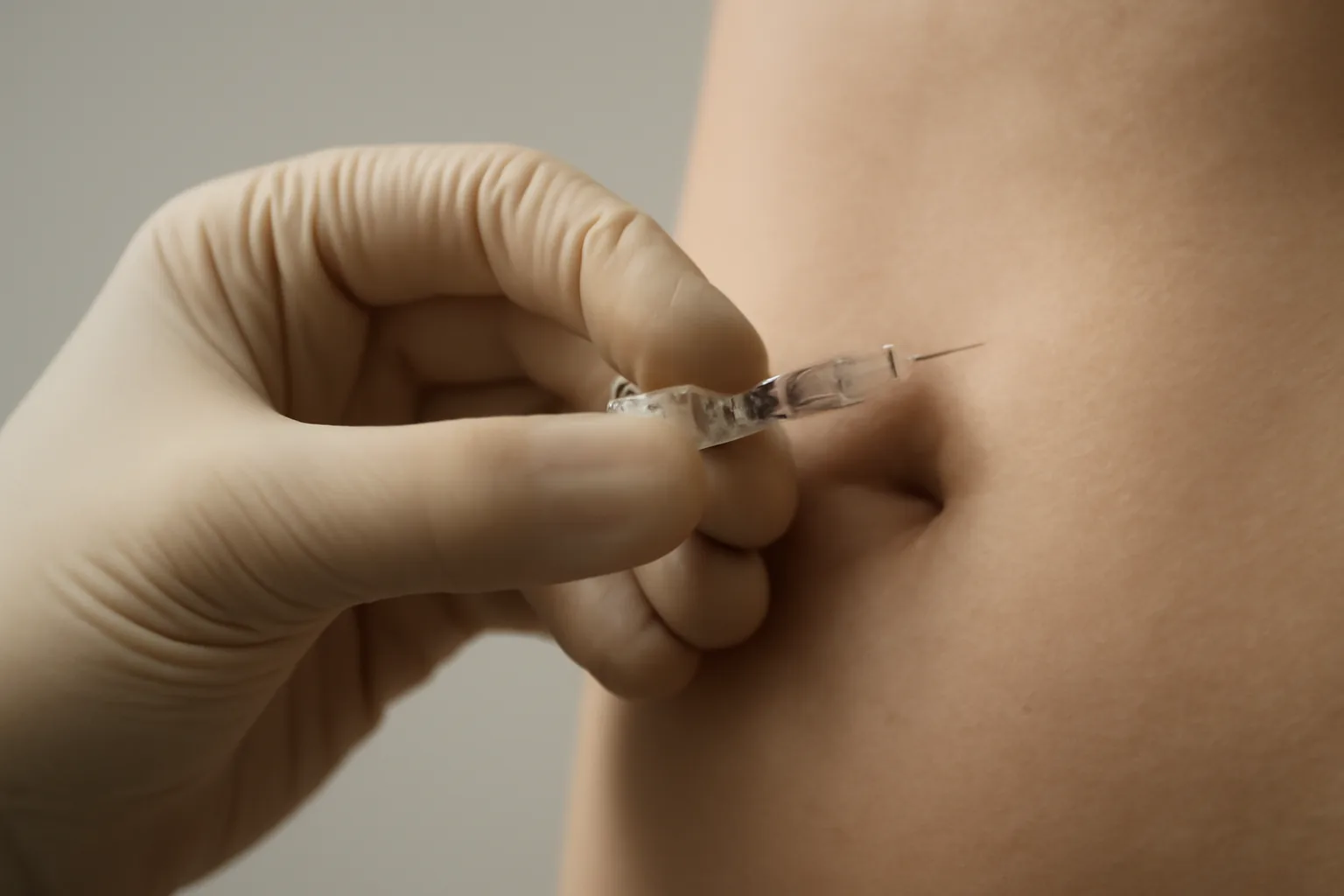
In practice, people running TB-500 research protocols use one of two routes: subcutaneous injection into abdominal fat, or intramuscular injection closer to the site of an actual injury (a shoulder, knee, or Achilles, for example). Subcutaneous is simpler and lower risk. You pinch a fold of fat, usually around the navel or lower abdomen, and inject with a short, thin needle (typically 29-31 gauge, insulin-syringe style). This is the same technique used for insulin or many other subcutaneous peptides, and it's what most compounding pharmacy guidance defaults to for a BPC-157/TB-500 blend. Intramuscular near the injury is the alternative some people use on the theory that local delivery concentrates the peptide where repair is needed. There is no published human trial comparing the two routes for TB-500 specifically, so this is reasoning from mechanism, not data. Thymosin beta-4 does have systemic activity (it's found in blood and tissues throughout the body), which is part of the argument for why site-specific injection may not matter as much as people assume, but that argument itself hasn't been tested head to head in a controlled trial. For a full walkthrough of technique, needle selection, and drawing up a blend correctly, see TB-500 how to inject.
Does injecting near the injury actually work better than a general site?
Nobody has a controlled study answering this directly for TB-500 in humans. The honest answer is: we don't know, and the theoretical case cuts both ways. The case for local injection rests on the idea that peptide concentration is highest right where it's delivered, before systemic clearance dilutes it. The case against is that thymosin beta-4 and its analogs act partly through binding actin and influencing cell migration broadly, not through a purely local receptor-site mechanism, so a peptide reaching general circulation may still find its way to inflamed or injured tissue. A 2026 sports medicine review of approved and unapproved peptide therapies for musculoskeletal injuries specifically flags the gap between mechanistic plausibility and demonstrated clinical outcomes for compounds in this category [4]. That's the closest thing to a direct verdict in the literature, and it's a caution, not an endorsement of any particular injection strategy. If you're going to inject near an injury site, standard safety practice still applies: avoid known blood vessels, avoid areas with scar tissue or reduced sensation, and rotate even within a target region rather than hitting the exact same point every time.
How do you rotate injection sites over a cycle?
Rotation matters more for comfort and tissue health than for efficacy. Repeated injections into the same square inch of skin cause local irritation, small bruises, and over weeks to months, lipohypertrophy (a lump of thickened fat tissue), the same problem seen in insulin users who don't rotate. A workable rotation for subcutaneous dosing: alternate between the left and right sides of the lower abdomen, then add the front of the thighs as a third and fourth zone. Within each zone, move at least an inch from the prior injection point. Some people also add the upper glute (subcutaneous fat over the glute, not deep IM) as a fifth rotation point. For how long a rotation schedule needs to last and when to reassess, see TB-500 cycle length. How the blend is stored between doses also affects site reactions; a peptide that's degraded or improperly reconstituted is more likely to cause irritation at the injection site. Details on that are in TB-500 storage and shelf life.
What injection sites should you avoid?
Avoid injecting directly into a joint capsule, into a tendon, into visibly bruised or broken skin, or into an area with a rash or infection. None of these are TB-500-specific rules; they're basic injection safety that applies to any subcutaneous or intramuscular peptide. Avoid injecting over a vein you can see or feel pulsing. If you draw back on the syringe (aspirate) and see blood, withdraw and pick a new site. Avoid the exact same pinpoint spot injection after injection. Beyond the lump-forming issue mentioned above, repeated trauma to one spot can cause skin thinning over time. If you have a bleeding disorder, are on blood thinners, or have compromised circulation in a limb, intramuscular injection near that limb carries more risk than subcutaneous elsewhere, and that's a conversation for whoever is supervising your use of a research peptide, not something to work out from a forum post.
Is TB-500 injection site choice regulated or standardized anywhere?
No. There is no FDA-approved TB-500 product, so there is no FDA drug label with an approved injection site instruction. You can confirm this yourself by searching Drugs@FDA, the FDA's database of approved drug products, where TB-500 does not appear [FDA Drugs@FDA database]. TB-500 also does not appear on the FDA's 503A bulk drug substances list (21 CFR 216.23) or the 503B bulks list (21 CFR 216.24), the lists that define what compounding pharmacies may legally use as source material under section 503A of the Food, Drug and Cosmetic Act (21 U.S.C. 353a) [FDA 503A bulks page; 21 CFR 216.23; 21 CFR 216.24; 21 U.S.C. 353a]. In practice this means TB-500 sits outside the standard compounding framework the FDA maintains for other peptides, and any dispensing that happens is happening in a gray area relative to that framework, not under an approved label. What you get instead is provider guidance from whoever supervises a research protocol, informed by general injectable peptide handling practices described in clinician-facing literature like the 2026 sports medicine primer on injectable peptide therapy [2], not a manufacturer's package insert.
How does needle gauge and depth change by site?
For subcutaneous injection in the abdomen or thigh, a 29-31 gauge, half-inch (12.7 mm) needle inserted at a 45 to 90 degree angle into pinched fat is standard, the same as typical insulin injection technique. For intramuscular injection near a joint like the shoulder or knee, people typically use a slightly longer needle (5/8 to 1 inch) at a 90 degree angle, going deeper into muscle tissue rather than the fat layer. Depth needs to account for how much subcutaneous fat sits over the muscle at that spot. This varies a lot person to person, which is exactly why generic depth advice for IM injection is less reliable than for subcutaneous. A 2026 review of approaches to peptide therapy safety and efficacy for musculoskeletal use notes that dosing and delivery approaches across this category of compounds are inconsistent and largely uncontrolled outside formal trials [4], which extends to injection technique as well as dose.
What about site-specific reactions: redness, bruising, and lumps?
Mild redness or a small bruise at the injection site is common and usually resolves within a few days. It's the same reaction you'd expect from any subcutaneous injection. A hard lump that doesn't go away after a week or two, especially if it's warm or increasingly tender, is different and worth stopping and getting looked at. That can indicate a local infection or an abscess, particularly if reconstitution or storage wasn't handled cleanly. Itching or a rash localized to the injection site, as opposed to systemic itching, points more toward a local irritant reaction than an allergic one, though true allergy to peptide components is possible and would usually show up as swelling that spreads beyond the injection point itself, or symptoms elsewhere on the body. None of this is unique to TB-500 or the BPC-157/TB-500 blend it's dispensed in; it's standard injection-site reaction triage that applies across subcutaneous peptide use generally.
Does the injection site affect detection in drug testing?
For athletes subject to anti-doping testing, injection site does not meaningfully change detectability, and it does not change legal status either way. TB-500 is prohibited under the World Anti-Doping Agency's list as a peptide related to thymosin beta-4, regardless of where or how it's injected. Detection science here is well developed. A 2012 paper in the Journal of Chromatography A built a liquid chromatography-mass spectrometry method to detect TB-500 in equine urine and plasma [5], and related equine work validated LC-MS detection of TB-500 alongside six other bioactive peptides in horse plasma [6]. A 2012 Drug Testing and Analysis paper characterized the N-terminal acetylated fragment found in TB-500 specifically because of its doping potential [7], and broader method papers describe screening for peptides under 2 kDa by direct urine injection and ion mobility mass spectrometry [8], solid-phase extraction techniques for small peptides from human urine [9], and comparisons of in vitro metabolism models (enzymes, serum, liver and kidney microsomes) used to predict how these peptides break down in the body for testing purposes [10]. A 2017 paper specifically studied adsorption effects for TB-500 and other doping-relevant peptides, which matters for how reliably these compounds are recovered and measured in the lab rather than for anything about injection technique [11]. None of this detection literature has anything to say about optimal injection site; it's entirely about post-administration analytical chemistry.
How does TB-500 injection differ from the BPC-157 side of the blend?
Because TB-500 is dispensed as a BPC-157/TB-500 blend rather than alone, in practice you're injecting both peptides at the same site, in the same syringe, at the same time. You are not choosing separate sites for each component. This matters for expectations: any injection-site reaction you see reflects the combined formulation, not one peptide in isolation. If you're trying to figure out whether an increase or decrease in either component changes your experience, changing the blend ratio (a provider decision) is the lever, not changing where you inject. For a side-by-side on how the standalone thymosin beta-4 peptide compares to TB-500 as it's actually used, see TB4 peptide vs TB500.
Where does this leave someone deciding on injection sites?
Subcutaneous abdominal injection is the lowest-friction, lowest-risk default, and it's what most providers guide people toward for a BPC-157/TB-500 blend. Rotate sites, use a short thin needle, and don't chase the exact injury site if reaching it means a deeper or riskier injection than you're comfortable giving yourself. If you want the provider-reviewed route for a BPC-157/TB-500 blend, including how the fulfilling pharmacy handles storage and dispensing, that's covered on TB-500 for sale. TB-500 Co doesn't compound or manufacture anything; we point you to the provider-reviewed and pharmacy-fulfilled option and explain what the evidence does and doesn't support. The evidence base for injection site specifically stays thin no matter which route you pick. The 2026 orthopaedic literature is honest about this: peptide therapeutics in this space carry real mechanistic interest and real analytical chemistry behind them, but clinical trial data on humans, let alone data on optimal injection site, isn't there yet [3][4].
Frequently asked questions
Is TB-500 injected subcutaneously or intramuscularly?
Both routes are used in practice. Subcutaneous (abdominal fat) is the more common default and is simpler and lower risk. Intramuscular injection near a specific injury site is used by some people based on the theory of local concentration, but there's no controlled human trial comparing the two routes for TB-500 specifically.
Can you inject TB-500 directly into an injured joint?
Injecting directly into a joint capsule is not standard practice and carries added infection and mechanical risk. Most protocols use intramuscular injection near, not into, the joint, or default to subcutaneous injection elsewhere on the body.
How often should you rotate injection sites?
Rotate at least an inch from the prior injection point each time, and rotate through at least two to four distinct zones (both sides of the lower abdomen, both thighs) over a cycle. This reduces bruising, irritation, and the lump formation (lipohypertrophy) that comes from repeated trauma to one spot.
What needle size is used for TB-500 injections?
Subcutaneous injections typically use a 29-31 gauge, half-inch needle, the same as standard insulin syringes. Intramuscular injections near an injury site typically use a slightly longer needle, 5/8 to 1 inch, at a 90 degree angle, depending on how much fat sits over the muscle at that location.
Does TB-500 injection site affect how well it works?
Nobody has controlled human data answering this. The theoretical argument for local injection is higher concentration at the injury; the argument against is that thymosin beta-4 analogs act partly through systemic mechanisms. A 2026 sports medicine review flags this exact gap between mechanism and demonstrated outcome for this category of peptide [4].
Is TB-500 the same as thymosin beta-4?
No. TB-500 is a synthetic analog built from a fragment of the thymosin beta-4 protein, not the full native molecule itself. They're related but not identical, and treating them as interchangeable, which some sources do, isn't accurate.
Can you buy TB-500 by itself?
No legitimate standalone TB-500 product exists. Where it's dispensed at all, it's formulated as a BPC-157/TB-500 blend through a compounding pharmacy working from a provider's protocol, not sold alone.
Is TB-500 approved by the FDA?
No. TB-500 does not appear in the FDA's Drugs@FDA database of approved products, and it is not on the FDA's 503A or 503B bulk drug substances lists that govern what compounding pharmacies may legally use [21 CFR 216.23; 21 CFR 216.24].
Is TB-500 banned for athletes?
Yes. TB-500, as a synthetic form related to thymosin beta-4, falls under substances prohibited by the World Anti-Doping Agency. Detection methods for it in urine and plasma are well documented in the analytical chemistry literature, including LC-MS methods originally developed for equine doping control [7][13].
What happens if you inject TB-500 into a vein by accident?
You shouldn't inject into a vein. Standard technique is to aspirate (pull back slightly on the plunger) before injecting; if blood appears, withdraw and choose a new site. Accidental intravenous injection of a peptide meant for subcutaneous or intramuscular use raises the risk of a faster, less controlled systemic exposure.
How do you know if an injection site reaction is serious?
Mild redness or a small bruise that resolves in a few days is normal. A lump that persists past a week or two, especially if it's warm, growing, or increasingly painful, is not normal and warrants stopping and getting it checked, since it can indicate infection.
Do you inject the BPC-157 and TB-500 at the same site?
Since TB-500 is dispensed as a combined BPC-157/TB-500 blend in one vial, yes, both peptides go in together at the same site in the same injection. You aren't choosing separate injection sites for each component.
Sources
- Journal of Chromatography B, 2024 (PMID 38382158): Developed and validated a method to quantify TB-500 and its metabolites in vitro and in rats, and screened fragments for wound-healing activity in cell culture.
- American Journal of Sports Medicine, 2026 (PMID 41476424): Provides physician-facing guidance on injectable peptide therapy handling in orthopaedic and sports medicine practice.
- Journal of the American Academy of Orthopaedic Surgeons Global Research & Reviews, 2026 (PMID 41490200): Reviews applications and challenges of therapeutic peptides in orthopaedics, noting the gap between mechanistic interest and clinical trial data.
- Sports Medicine (Auckland, N.Z.), 2026 (PMID 41966639): Reviews safety and efficacy of approved and unapproved peptide therapies for musculoskeletal injuries, flagging inconsistent evidence for this compound category.
- Journal of Chromatography A, 2012 (PMID 23084823): Developed an LC-MS method for doping control detection of TB-500 in equine urine and plasma.
- Analytical Biochemistry, 2017 (PMID 28887173): Studied adsorption effects for TB-500 and other doping-relevant peptides, relevant to reliable lab recovery and measurement.
- Drug Testing and Analysis, 2012 (PMID 22962027): Synthesized and characterized the N-terminal acetylated 17-23 fragment of thymosin beta-4 found in TB-500 specifically due to its suspected doping potential.
- Journal of Separation Science, 2016 (PMID 26578461): Describes a method for screening peptides under 2 kDa via direct urine injection and ion mobility mass spectrometry.
- Analytical and Bioanalytical Chemistry, 2013 (PMID 23318763): Validated LC-MS doping control detection of TB-500 alongside six other bioactive peptides in horse plasma.
- Journal of Proteomics, 2016 (PMID 27569051): Compared in vitro model systems (enzymes, serum, liver and kidney microsomes) for metabolism of synthetic doping peptides used in detection science.
- Drug Testing and Analysis, 2016 (PMID 26472487): Describes solid-phase extraction methods for small biologically active peptides from human urine.
- FDA, Drugs@FDA database: TB-500 does not appear as an FDA-approved drug product in the Drugs@FDA database.
- 21 CFR 216.23, FDA 503A Bulks List: Defines the bulk drug substances that compounding pharmacies may legally use under section 503A; TB-500 is not on this list.
- 21 CFR 216.24, FDA 503B Bulks List: Defines the bulk drug substances outsourcing facilities may legally use under section 503B.
- 21 U.S.C. 353a, pharmacy compounding statute: Establishes the statutory framework under which pharmacy compounding of substances like the BPC-157/TB-500 blend is regulated.