Last updated 2026-07-25
TL;DR
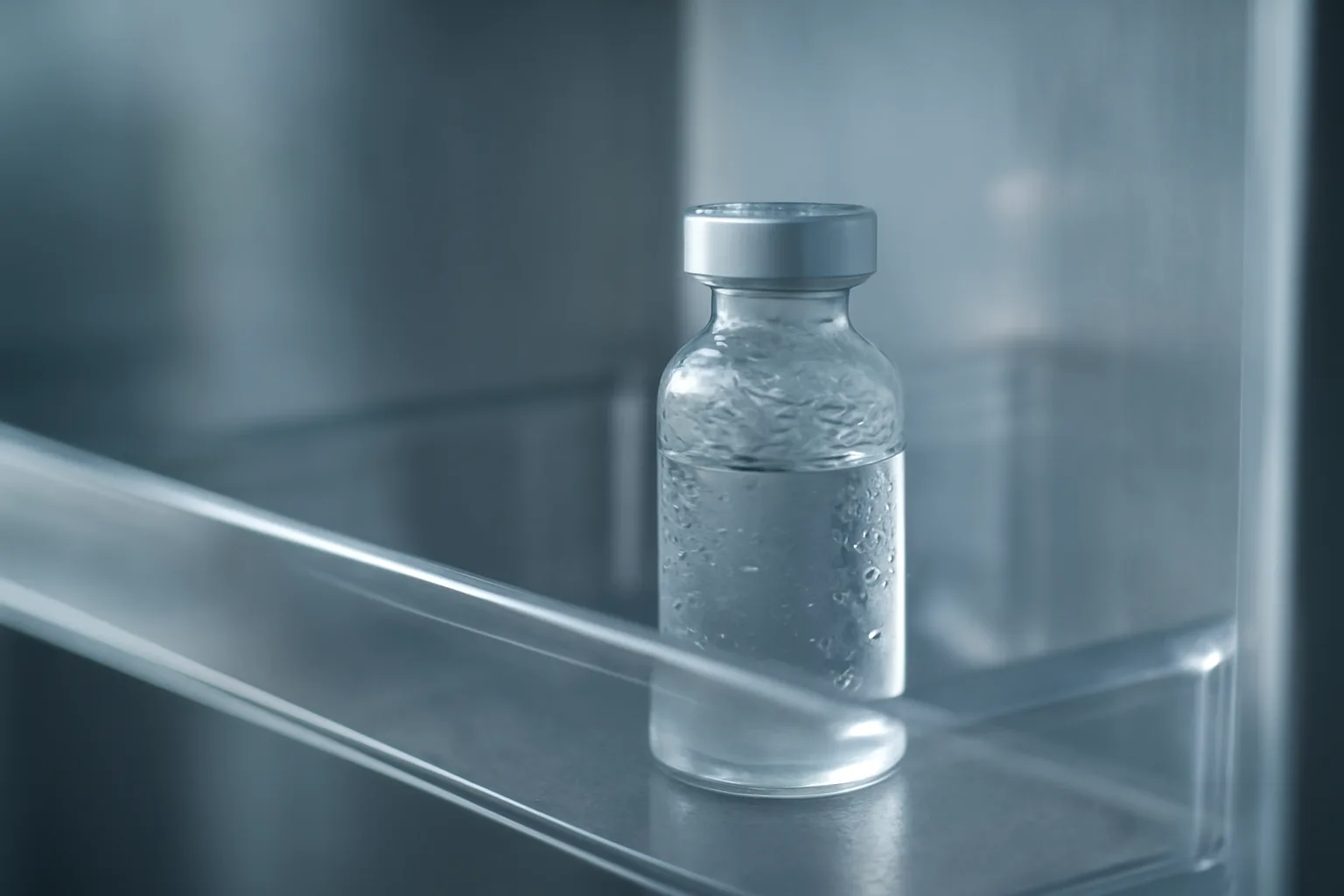
Lyophilized (freeze-dried) TB-500 is stable at room temperature short-term but should be kept refrigerated or frozen for longer storage. Once reconstituted with bacteriostatic water, it needs continuous refrigeration (roughly 2-8°C) and is generally used within weeks, not months. Heat, light, and repeated freeze-thaw cycles degrade peptide integrity faster than most sellers admit.
does TB-500 need to be refrigerated before it's mixed?
Lyophilized peptide, the white or off-white powder or pellet sitting in a sealed vial, is the most stable form TB-500 ever exists in. Freeze-drying removes water, and water is what drives most peptide degradation (hydrolysis, deamidation, aggregation). In that dry state, TB-500 can tolerate room temperature for short stretches, days to a couple weeks, without meaningful loss of integrity. That said, "can tolerate" is not the same as "ideal." Heat accelerates every degradation pathway a peptide has. If you're storing unmixed vials for any real length of time, a refrigerator (roughly 2-8°C) is the right call, and a freezer is better if you're holding stock for months. This isn't unique to TB-500. It's basic peptide chemistry that applies to insulin, GLP-1 drugs, and virtually every therapeutic peptide on the market. None of the analytical chemistry papers on TB-500 were designed to answer a consumer storage question directly. They're doping-control and pharmacokinetic studies, built to detect the peptide and its metabolites in blood, urine, or tissue, not to establish a shelf-life spec sheet. So treat storage guidance as extrapolated from general peptide stability science, not from a study that put TB-500 vials in different fridges and measured degradation curves. Nobody has published that study.
does reconstituted (mixed) TB-500 need to stay refrigerated?
Yes. Once you add bacteriostatic water or sterile water to the lyophilized powder, the clock starts differently. Reconstituted TB-500 is now a liquid solution, and liquid peptide solutions degrade faster than powder, full stop. Refrigeration at 2-8°C is standard practice for the mixed vial, and it should stay there between uses. Most practitioner guidance for reconstituted peptides in this class puts a practical usable window at somewhere between 2 and 4 weeks under refrigeration, sometimes stretching to 6 weeks if bacteriostatic water (which contains 0.9% benzyl alcohol as a preservative) was used instead of plain sterile water. That range is a general peptide-handling convention, not a number derived from a TB-500-specific stability trial, because no such trial exists in the public literature. Don't leave a mixed vial on a counter, in a gym bag, or in a car. Bathroom cabinets are also bad, because humidity and temperature swings both work against you. The fridge door is fine. The back of the fridge, away from the light and away from the freezer coils, is better.
can TB-500 be frozen, and does freezing damage it?
Unmixed, lyophilized TB-500 can generally be frozen for longer-term storage, and freezing is actually gentler on the dry powder than repeated temperature swings at room temperature. Freezing pauses most chemical degradation reactions. Once reconstituted, freezing gets more complicated. Repeated freeze-thaw cycles are one of the more reliable ways to damage a peptide solution: each cycle stresses the peptide structure and can promote aggregation or fragmentation. If you must freeze a mixed vial, the working assumption in peptide-handling practice is to freeze it once, thaw it once, and not refreeze. In practice, most people who reconstitute TB-500 skip freezing the mixed solution entirely and just keep it in the fridge for the few weeks they're using it.
how does temperature actually break down a peptide like TB-500?
Peptides are chains of amino acids held together by bonds that are chemically fragile compared to small-molecule drugs. Heat speeds up hydrolysis (water molecules attacking and breaking peptide bonds), deamidation (a slow chemical conversion of certain amino acid residues), and aggregation (peptide molecules clumping together into larger, often inactive structures). All three processes run faster as temperature rises. Light matters too, especially UV light, which can drive oxidation of specific amino acid side chains. That's part of why vials come in amber or opaque packaging, and why keeping vials in a drawer or box inside the fridge rather than in direct light is a reasonable habit. The chromatography and mass-spec literature on TB-500 gives a window into how detectable and chemically distinct the compound is under lab conditions, not how it behaves in your fridge. A 2024 paper developed a UHPLC-Q-Exactive Orbitrap MS/MS method to simultaneously quantify TB-500 and its metabolites in in-vitro experiments and in rats, screening for wound-healing activity in vitro [1]. That kind of analytical work confirms TB-500 and its breakdown products are measurable and distinguishable from each other with modern instrumentation, which is exactly why doping labs can build detection methods around it, but it doesn't hand you a consumer shelf-life number.
is there a difference between TB-500 and native thymosin beta-4 for storage purposes?
This matters more than most sellers let on. Native thymosin beta-4 is a naturally occurring 43-amino-acid protein made in the body. TB-500 sold in research contexts is typically described as a synthetic peptide built around an active fragment of thymosin beta-4, and analytical work has specifically characterized an N-terminal acetylated 17-23 fragment of thymosin beta-4 identified in material sold as TB-500, flagged in the literature for its doping potential [2]. They are related, not identical. Fragment peptides and full-length proteins don't necessarily share the same stability profile, aggregation tendencies, or degradation pathways, even when they share a biologically active region. So when someone tells you "thymosin beta-4 storage studies show X," ask whether they mean the native full protein or the synthetic fragment product sold as TB-500. The literature treats these as chemically distinct entities worth separate detection methods, and your storage assumptions should track that distinction rather than blur it. If you want the fuller comparison of how these two relate to BPC-157 as well, that's covered on the TB-500 vs BPC-157 page.
how do I know if my TB-500 has gone bad?
There's no consumer-grade test kit for this, so you're relying on visual and practical cues, which are imperfect. A reconstituted solution that turns cloudy, develops visible particles, or changes color from clear to yellow or amber is a signal something has changed, and it's not one you want to bet your money or your tissue on. A vial that's been left unrefrigerated for an extended stretch, especially in heat (a hot car, a sunny windowsill), should be treated as compromised even if it still looks clear. Visual clarity is a weak proxy for chemical integrity. Peptides can degrade at the molecular level well before you'd see it with your eyes. The honest answer is: if you're not sure how it was stored or shipped, the safer assumption is that it's degraded, not that it's fine. There's no dramatic "expiration cliff" documented for this specific product, just a general decline curve that gets steeper with heat exposure and time.
how should TB-500 be shipped to preserve it?
Reputable cold-chain practice for peptides uses insulated packaging with ice packs or gel packs, shipped for the shortest transit time reasonably available. That's standard across the peptide and biologic supply chain generally, not something specific to one brand or seller. If a vial arrives warm to the touch, or the ice packs have fully melted and gone room temperature, that's a legitimate reason to question the product's integrity before you use it. This is one of the practical advantages of going through a provider-reviewed process with proper cold-chain handling and a named pharmacy partner responsible for fulfillment, rather than a listing that ships in a padded envelope with no temperature control at all. TB-500 Co works with a provider-reviewed pathway that connects to a compounding pharmacy partner for fulfillment of the BPC-157/TB-500 blend, which is the only form this material is actually dispensed in. There's no standalone TB-500 SKU on the market that a reader can obtain in isolation.
what does the actual research literature say about TB-500's evidence base?
Nearly everything published on TB-500 specifically is preclinical, meaning animal studies, in-vitro (test tube or cell culture) experiments, or analytical chemistry work built for anti-doping detection. There is no large human clinical trial establishing dosing, efficacy, or long-term safety for TB-500 in the way there is for an FDA-approved drug. A 2026 review titled "Injectable Peptide Therapy: A Primer for Orthopaedic and Sports Medicine Physicians," published in The American Journal of Sports Medicine, frames this category of injectable peptides for physicians who are fielding patient questions about them, which itself signals how far ahead of formal approval the consumer interest has run [3]. Separately, a 2026 paper in the Journal of the American Academy of Orthopaedic Surgeons' Global Research & Reviews covers therapeutic peptides in orthopaedics broadly, including the applications, challenges, and future directions of the category [4]. And a 2026 Sports Medicine (Auckland) paper specifically addresses the safety and efficacy of approved versus unapproved peptide therapies for musculoskeletal injuries and athletic performance, a framing that puts TB-500 squarely in the "unapproved" bucket next to substances with actual FDA sign-off [5]. None of this is a knock against the biology being interesting. It's a statement about what's actually been proven in humans versus what's been extrapolated from rats, cell cultures, and mass spectrometers. For the fuller regulatory picture, see is TB-500 FDA approved.
is TB-500 legal to compound, and does that affect how it's stored or sold?
TB-500 is not an FDA-approved drug, and it doesn't appear on the FDA's 503A bulk drug substances list (21 CFR 216.23) or the 503B bulks list (21 CFR 216.24), the lists that govern what compounding pharmacies can legally use as raw ingredients under 21 U.S.C. 353a [6][7][8]. The FDA maintains a running list of bulk drug substances nominated for use in compounding, which is a separate thing from substances actually approved for that use [9]. This matters for storage indirectly: a compounding pharmacy operating under proper pharmaceutical handling standards has cold-chain infrastructure, temperature-monitored shipping, and batch documentation that a gray-market seller shipping from an unregulated lab typically does not. That difference in supply chain discipline is often a bigger driver of whether the vial in your fridge is actually intact than any storage tip you follow at home.
why is TB-500's stability relevant to athletes specifically?
The World Anti-Doping Agency prohibits TB-500 (and thymosin beta-4-related peptides generally) at all times under its Prohibited List, which matters for any athlete subject to testing, regardless of storage questions. Analytical chemists have built out a fairly deep detection toolkit for this specific compound: liquid chromatography-mass spectrometry methods for TB-500 in equine urine and plasma [10], adsorption studies looking at how TB-500 and other doping-relevant peptides behave on lab surfaces during testing [11], and broader reviews of detecting peptidic drugs and analogs in sports doping controls [12]. There's also a body of methodological work on how these peptides get metabolized and screened: in-vitro models for studying small peptide hormone metabolism in drug testing [13], comparisons of enzyme and tissue-based model systems for synthetic doping peptide metabolism [14], solid-phase extraction techniques for isolating small bioactive peptides from human urine [15], and ion-mobility mass spectrometry approaches for screening peptides under 2 kDa directly from urine samples [16]. The sheer volume of detection-method literature tells you something: labs consider TB-500 detectable and worth building assays around, which is the opposite of a compound that flies under the radar.
what's the honest bottom line on storing TB-500?
Keep unmixed, lyophilized vials refrigerated or frozen if you're holding them for any real length of time, though short room-temperature stretches during shipping or a brief wait before use aren't catastrophic. Once reconstituted, refrigerate continuously at roughly 2-8°C, use it within a matter of weeks, and don't refreeze a solution that's already been frozen and thawed once. Protect vials from light and heat at every step, question anything that arrived warm or looks cloudy, and remember that none of this storage guidance comes from a TB-500-specific stability trial. It's extrapolated from general peptide chemistry and from how the pharmaceutical industry handles comparable biologics. If you want the fuller safety picture beyond just storage, TB-500 side effects and TB-500 in women cover what the preclinical and analytical literature actually documents.
Frequently asked questions
how long does TB-500 last unrefrigerated?
Lyophilized (powder) TB-500 can generally tolerate room temperature for days to a couple weeks without major issues, since removing water makes the dry form far more stable. Reconstituted liquid solution is much less forgiving; extended unrefrigerated time, especially in heat, should be treated as a real risk to potency, not a minor inconvenience.
can I put TB-500 in the freezer?
Unmixed lyophilized powder generally tolerates freezing well for longer-term storage. Reconstituted solution is riskier to freeze because freeze-thaw cycles can damage peptide structure; if you do freeze a mixed vial, plan on one freeze and one thaw only, never repeated cycles.
how long does reconstituted TB-500 last in the fridge?
Common practitioner convention for this class of peptide puts usable refrigerated shelf life at roughly 2 to 4 weeks, sometimes longer with bacteriostatic water's benzyl alcohol preservative. This figure comes from general peptide-handling practice, not a TB-500-specific stability study, since no such published trial exists.
does TB-500 need to be shipped cold?
Reputable practice ships peptides in insulated packaging with ice or gel packs to limit heat exposure in transit. If a vial arrives warm or the ice packs have fully melted, treat the product's integrity as questionable rather than assuming it's fine.
is TB-500 the same thing as thymosin beta-4?
No. Native thymosin beta-4 is a naturally occurring 43-amino-acid protein. TB-500 sold in research and compounding contexts is generally a synthetic fragment built around an active region of that protein, and analytical chemistry has specifically characterized an N-terminal acetylated 17-23 fragment identified in TB-500 products. They're related, not identical.
can I buy standalone TB-500?
There is no standalone TB-500 SKU in the legitimate compounding market. It's dispensed as a BPC-157/TB-500 blend through compounding pharmacies. TB-500 is also absent from both the FDA's 503A and 503B bulk drug substance lists, which govern what pharmacies can legally compound with.
is TB-500 FDA approved?
No. TB-500 is not an FDA-approved drug and doesn't appear on the Drugs@FDA database of approved products. It also isn't on the FDA's 503A or 503B bulk drug substances lists that govern compounding pharmacy ingredients. See our full breakdown on the is TB-500 FDA approved page for the regulatory detail.
does light exposure damage TB-500?
Yes, in principle. UV and general light exposure can drive oxidation in certain amino acid side chains, a known peptide degradation pathway. Storing vials in a drawer or dark container inside the fridge, rather than exposed on a shelf, is a reasonable precaution even though no TB-500-specific light-exposure study has been published.
how do I know if TB-500 has degraded?
Visual cues (cloudiness, particles, a color shift toward yellow) suggest a compromised solution, but a clear appearance doesn't guarantee integrity since molecular degradation can precede visible change. Storage history matters more: if a vial sat unrefrigerated in heat for any real stretch, treat it as degraded even if it looks normal.
is TB-500 banned for athletes?
Yes. TB-500 and thymosin beta-4-related peptides are prohibited at all times under the World Anti-Doping Agency's Prohibited List. Anti-doping labs have published multiple detection methods specifically for TB-500 in urine and plasma, including equine testing protocols, so it is a compound labs actively screen for.
does bacteriostatic water extend TB-500's shelf life once mixed?
Bacteriostatic water contains 0.9% benzyl alcohol as a preservative, which helps limit microbial growth in a multi-use vial compared to plain sterile water. That can extend practical usable window somewhat, but it doesn't stop chemical degradation from heat or time, so refrigeration still matters regardless of which diluent you use.
what's the difference in storage needs between TB-500 and BPC-157?
Both are handled similarly in practice: lyophilized powder is more stable than reconstituted solution, and refrigeration is standard for mixed vials of either peptide. Since TB-500 is dispensed as a BPC-157/TB-500 blend, the two share a single vial and a single storage protocol in that combined product, not two separate schedules.
Sources
- PubMed, Journal of Chromatography B (2024): A UHPLC-Q-Exactive Orbitrap MS/MS method was developed to simultaneously quantify TB-500 and its metabolites in in-vitro experiments and rats, with wound-healing activity screening in vitro.
- PubMed, Drug Testing and Analysis (2012): Analytical chemists synthesized and characterized the N-terminal acetylated 17-23 fragment of thymosin beta 4 identified in TB-500, flagged for doping potential.
- PubMed, The American Journal of Sports Medicine (2026): A 2026 primer on injectable peptide therapy was published specifically to inform orthopaedic and sports medicine physicians, reflecting how far consumer interest has outpaced formal clinical evidence.
- PubMed, JAAOS Global Research & Reviews (2026): A 2026 review covers therapeutic peptides in orthopaedics, including applications, challenges, and future directions for the category.
- PubMed, Sports Medicine Auckland (2026): A 2026 paper addresses the safety and efficacy of approved versus unapproved peptide therapies for musculoskeletal injuries and athletic performance.
- eCFR, 21 CFR 216.23: 21 CFR 216.23 establishes the final 503A bulk drug substances list that governs what pharmacies can legally use in traditional compounding.
- eCFR, 21 CFR 216.24: 21 CFR 216.24 establishes the 503B bulk drug substances list for outsourcing facility compounding.
- Cornell Law School, Legal Information Institute, 21 U.S.C. 353a: 21 U.S.C. 353a is the statute governing pharmacy compounding conditions under federal law.
- FDA, Bulk Drug Substances Nominated for Use in Compounding: FDA maintains a running list of bulk drug substances nominated for compounding use, distinct from substances formally approved for that purpose.
- PubMed, Journal of Chromatography A (2012): A liquid chromatography-mass spectrometry method was developed for doping control detection of TB-500 in equine urine and plasma.
- PubMed, Analytical Biochemistry (2017): A study examined adsorption effects of doping-relevant peptides including TB-500 during laboratory analysis.
- PubMed, Expert Review of Proteomics (2014): A review covers current status and future directions for detecting peptidic drugs and analogs in sports doping controls.
- PubMed, Journal of Peptide Science (2015): In-vitro models were developed for metabolic studies of small peptide hormones in sport drug testing.
- PubMed, Journal of Proteomics (2016): A comparison study evaluated various in-vitro model systems including enzymes, serum, and liver/kidney microsomes for metabolizing synthetic doping peptides.
- PubMed, Drug Testing and Analysis (2016): Solid-phase extraction methods were developed for isolating small bioactive peptides from human urine using cartridges and microelution plates.
- PubMed, Journal of Separation Science (2016): An ion mobility mass spectrometry method was developed to screen peptides under 2 kDa by direct urine injection.